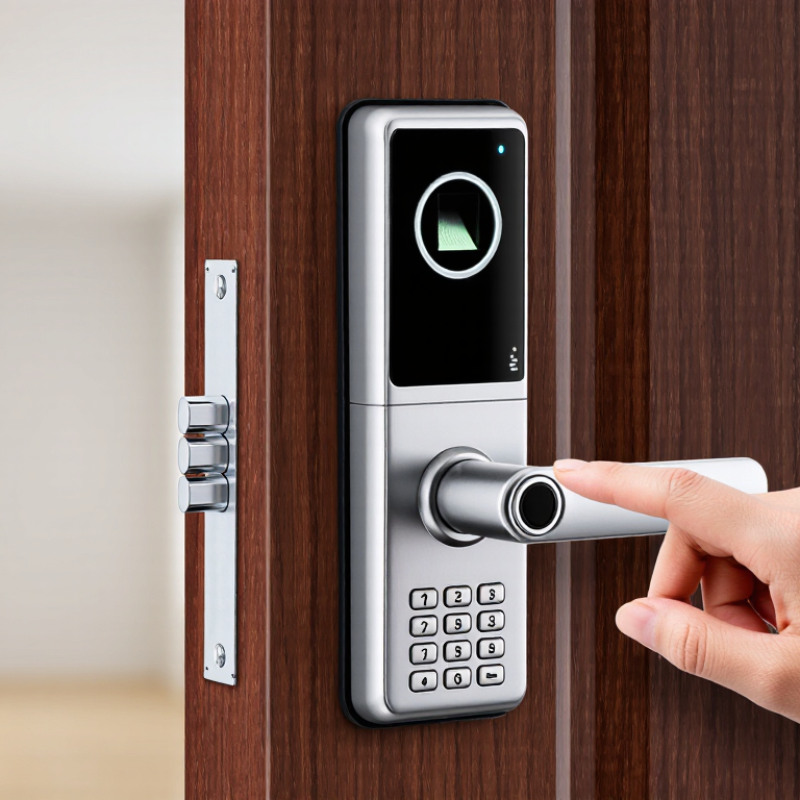
Top 10 Finger Scan Door Locks for Homes and Offices
A Finger Scan Door Lock can make everyday entry quicker: place a finger on the reader, wait for recognition, and turn the handle. But convenience is only part of the decision. Sensor response, backup entry, battery alerts, weather resistance, and user management all matter at home or in a busy office. A reader that struggles with damp fingers or a worn print can turn a smooth morning into a frustrating one. Small details count.
Security technologist Bruce Schneier has said, “Security is a process, not a product.” That principle is useful when comparing fingerprint locks. A reliable choice needs more than a fast scanner; owners should also understand how access is added or removed, what happens during a power failure, and how the lock handles failed scans. This guide reviews ten options for homes and workplaces, focusing on practical features, installation considerations, and everyday usability. Not every model suits every door. Some trade a lower price for fewer controls, while others may require careful setup or compatible hardware. Check the door measurements and the manufacturer’s instructions before buying. And test the backup method. The right lock should feel straightforward in daily use, while offering clear safeguards when conditions are less than ideal.
Fingerprint Recognition Basics: FAR, FRR, and ISO/IEC 19795
Fingerprint locks are only as dependable as their measurements. The false acceptance rate (FAR) estimates how often an unauthorised finger is accepted; the false rejection rate (FRR) measures how often an enrolled user is refused. Lowering one can raise the other. A strict threshold may reject a resident with cold, dry fingers. A lenient one may admit a closer impostor match. Small details matter.
ISO/IEC 19795-1:2021 sets principles for biometric performance testing and reporting, including clear test conditions and error-rate definitions. For context, NIST’s Fingerprint Vendor Technology Evaluation, documented in NISTIR 7296, reported identification rates around 99.6% with two fingers in a 10,000-person test. That is useful, but easy to overread: it was a controlled identification evaluation, not a test of residential door locks. A lock’s FAR and FRR depend on its sensor, threshold, enrolled users, and test method. Ask whether published figures come from independent testing and include sample sizes. Not a guarantee. Check performance with real household fingers, including damp hands, worn prints, and repeated attempts. ISO-style reporting helps comparisons, but one carefully chosen number cannot describe every doorway.
Fingerprint Recognition: FAR and FRR at Different Thresholds
Illustrative example, not product test data or an ISO benchmark. FAR (False Acceptance Rate) is the proportion of impostor attempts incorrectly accepted; FRR (False Rejection Rate) is the proportion of genuine attempts incorrectly rejected. A stricter matching threshold typically reduces FAR while increasing FRR. ISO/IEC 19795 provides methods for biometric performance testing and reporting; it does not prescribe these values.
How to Assess ANSI/BHMA Grades and Lock-Endurance Ratings
ANSI/BHMA grades help buyers judge a lock’s tested mechanical performance, but the applicable standard matters. A fingerprint reader may sit on a lock body tested under a different standard than a conventional cylindrical lock. For example, ANSI/BHMA A156.2 specifies endurance testing for cylindrical locks; Grade 1 models are tested through one million operating cycles. This figure is a laboratory benchmark, not a promise that every installed lock will last that long. Installation, door alignment, weather, and daily use all affect wear.
A grade does not rate fingerprint accuracy, data security, or backup power. Check the product documentation for the exact ANSI/BHMA standard, grade, and test scope. BHMA certification indicates that a product was tested against the relevant standard, but confirm the specific model appears in the certification listing. One easy-to-miss detail: a strong lock body cannot compensate for a poorly fitted door.
Tips: Compare the grade with expected traffic. A busy office entrance needs tougher endurance than a lightly used interior door. Check for a mechanical key or other documented backup, too. Small detail, big difference. Recheck the door’s latch alignment; a bolt scraping the strike plate adds strain with every use.
Top 10 Finger Scan Door Locks for Homes and Offices - How to Assess ANSI/BHMA Grades and Lock-Endurance Ratings
This is a ranked guide to common fingerprint-lock configurations, not a ranking of tested brands or individual models. The ranking reflects general use-case suitability. ANSI/BHMA grades and endurance results must be confirmed for the exact lock model and hardware type; biometric features alone do not establish a grade.
| Rank | Fingerprint lock configuration | Suitable setting | Key assessment points | ANSI/BHMA grade to verify | Endurance evidence to request | Practical considerations |
|---|---|---|---|---|---|---|
| 1 | Fingerprint-enabled deadbolt with mechanical key backup | Most residential entry doors | Check door and bore compatibility, bolt throw, strike reinforcement, emergency access, and enrolled-user capacity. | Confirm the applicable standard and grade for the deadbolt hardware. Do not assume the fingerprint reader has a separate ANSI/BHMA grade. | Request a model-specific test report stating the standard, grade, test conditions, and cycle result. | A mechanical key backup can provide an alternative when batteries are depleted or the reader is unavailable. |
| 2 | Fingerprint smart deadbolt with local app or wireless connectivity | Homes needing remote status or user management | Assess local operation during network outages, account security, update policy, power-loss behavior, and mechanical override. | Verify the physical lock's applicable grade and certification; connectivity features do not indicate lock strength. | Ask for the endurance rating of the complete lock assembly, not just the electronic module. | Remote access depends on the system's communications setup and should not be treated as a substitute for a certified lock rating. |
| 3 | Fingerprint lever lock with keyed mechanical override | Interior office doors and accessible residential doors | Check handing, latch function, fire-door requirements, lever return, and whether the lock is intended for the door's use. | Verify the grade under the standard applicable to the specific lockset type and installation. | Request cycle-test documentation for the lever, latch, and locking mechanism as applicable. | Lever operation can be easier than a thumb-turn for users with limited grip strength; confirm the complete door setup meets applicable accessibility requirements. |
| 4 | Fingerprint mortise lock with mechanical key override | Commercial offices and doors already prepared for mortise hardware | Confirm mortise case dimensions, door preparation, handing, latch and deadbolt functions, and compatibility with existing access controls. | Ask whether the mortise lock has been tested and graded under the applicable ANSI/BHMA mortise-lock standard. | Obtain the reported endurance cycles and the test standard edition for the exact mortise-lock model. | Mortise locks require compatible door preparation; retrofit work may be more involved than replacing a standard deadbolt. |
| 5 | Fingerprint cylindrical lever lock for managed office access | Low- to medium-traffic office doors | Review user enrollment and deletion, audit features, privacy settings, fail-safe or fail-secure behavior, and credential fallback. | Check the applicable grade for the cylindrical lock hardware and whether the certification covers the supplied configuration. | Request the tested cycle count and confirm which components were included in the test. | For shared workplaces, establish a process to remove access promptly when staff or contractors leave. |
| 6 | Fingerprint access-control mortise lock with administrator-managed users | Higher-use office entrances and controlled-access areas | Assess administrator controls, credential recovery, event logging, power arrangements, and integration with the building's access system. | Verify both the lock's applicable ANSI/BHMA grade and any separate requirements for electrified locking hardware. | Request separate, model-specific evidence for mechanical endurance and any applicable electrical-device testing. | Confirm that the selected locking behavior is appropriate for the door, occupancy, and local life-safety requirements. |
| 7 | Fingerprint retrofit deadbolt with an interior motorized thumb-turn | Existing homes where exterior door hardware should remain unchanged | Check compatibility with the existing deadbolt, cylinder, door thickness, tailpiece, and interior clearance. | Verify the grade of the underlying deadbolt separately from the retrofit device; a retrofit reader does not upgrade the deadbolt's grade. | Request cycle results for the exact installed combination, if tested; component-only results may not represent the full assembly. | Installation and motor operation depend on the condition and alignment of the existing deadbolt. |
| 8 | Fingerprint deadbolt with keypad and temporary access codes | Rental homes, guest access, and small offices | Check code expiration and deletion controls, fingerprint enrollment limits, lockout behavior, and mechanical backup. | Look for a documented grade for the mechanical lock portion; keypad or biometric functions do not establish that grade. | Require a published or independently documented endurance result for the lock model and relevant standard. | Temporary codes can offer a non-biometric alternative for visitors; review how codes are issued and revoked. |
| 9 | Fingerprint lock for a secondary or interior door | Home offices, storage rooms, and low-traffic interior spaces | Identify whether the door needs privacy, passage, or security locking; check emergency egress and override options. | Confirm whether the product is graded for the intended lock function. A residential interior lock may not be comparable to a commercial entry lock. | Compare endurance results only when the test standard and lock category are the same. | Choose the locking function according to the door's purpose rather than relying on fingerprint access alone. |
| 10 | Fingerprint-controlled gate or outbuilding lock | Covered exterior gates, workshops, and ancillary buildings | Check weather exposure, corrosion resistance, mounting method, gate alignment, power source, and a reliable emergency release. | Do not assume a door-lock ANSI/BHMA grade applies to gate hardware; confirm the certification and intended application. | Request endurance and environmental test information for the exact gate-lock model and installation conditions. | Outdoor exposure and gate movement can affect reliability; use hardware specifically intended for those conditions. |

How to interpret grades and endurance: ANSI/BHMA grades apply to defined hardware categories and test standards, so the relevant standard depends on whether the product is a deadbolt, cylindrical lock, mortise lock, or another device. Grade numbers are not interchangeable across every lock category. Endurance is reported as cycles under a specified test; compare cycle counts only when the standard, grade, product category, and test conditions are comparable. Before purchase, confirm the exact model's certification, applicable standard and edition, grade, and model-specific endurance documentation.
Top 10 Finger Scan Door Locks Compared by Access and User Capacity
A useful Top 10 comparison should separate fingerprint slots from named users. One household member may register several fingers, while a shared office may need many individual profiles. Check whether each lock also supports PINs, cards, keys, or remote access, and whether those credentials count toward a separate limit. Capacity is not identity. A large fingerprint limit does not automatically mean convenient staff management.
Grand View Research valued the global smart-lock market at about $2.4 billion in 2023 and projected 19.6% annual growth from 2024 to 2030. That market context makes careful specification reading worthwhile, but it does not prove that any lock is more secure. Compare the stated number of fingerprints, users, and administrator accounts, plus how quickly credentials can be added or removed. For a small office, easy offboarding may matter more than a high enrollment ceiling.
NIST SP 800-63B treats biometrics as part of an authentication process, not a complete substitute for other safeguards. Its guidance is written for digital identity systems, so it should not be mistaken for a door-lock certification. Still, it is a useful reminder to examine fallback entry, failed-scan behavior, and account controls. A capacity table can look tidy; real use is messier. Check the exact model documentation before relying on advertised totals.
Security Features: Encryption, Audit Logs, and Backup Entry Methods
When comparing fingerprint door locks, look beyond scan speed. A lock should protect stored fingerprint data with encryption, both during transfer and within the device. Check the manufacturer’s security documentation rather than assuming every model handles data the same way. Some systems store templates locally; others connect to an app or hub. That difference affects privacy and what happens during a network outage. Audit logs can show who unlocked the door and when, which is useful for shared homes or small offices. Keep access to those records limited, since entry times reveal routines.
Tips: Test the backup method before installation. Try the keypad with the door open, and check whether a physical key or external battery contact is available. Keep backup keys somewhere secure, not under the doormat. Small detail, big difference.
No fingerprint reader works perfectly every time. Damp fingers, worn skin, or a dusty sensor can cause a failed scan at an inconvenient moment. Choose a lock with more than one backup entry method, and confirm it still operates during a power or Wi-Fi failure. Review and remove old user profiles when roommates, staff, or contractors no longer need access. I would also check the audit log occasionally; it is easy to enable a feature and then forget it exists.
Choosing for Homes or Offices: Installation, Power, and IEC 60529 IP Ratings
A finger-scan lock should fit the door before its features impress you. Measure door thickness, backset, and the space around the handle; a few millimeters can affect latch alignment. On older office doors, check the existing bore and strike plate before drilling. Poor alignment makes a motor work harder and can drain batteries sooner. I would also confirm that installation does not interfere with a door’s required fire-safety hardware. Easy to overlook.
Power needs differ by use. A home may see a few entries each day, while a shared office can generate repeated scans and motor cycles. Check the manufacturer’s stated battery type, low-power warning, and emergency access method. Keep replacement cells available, and test the warning before relying on it. There is no universal battery-life figure: usage, temperature, and door friction all matter.
For outdoor or damp locations, read the complete IP code, not just “weather-resistant.” IEC 60529 defines IP ratings: the first digit concerns solid particles, and the second concerns water. For example, IP54 indicates dust protection and resistance to splashing water; IP65 is dust-tight and tested against water jets. These ratings describe laboratory test conditions, not every real doorway. A covered porch may still expose a lock to wind-driven rain. I’d check the rating against the actual exposure—and admit that site conditions are easy to misjudge.